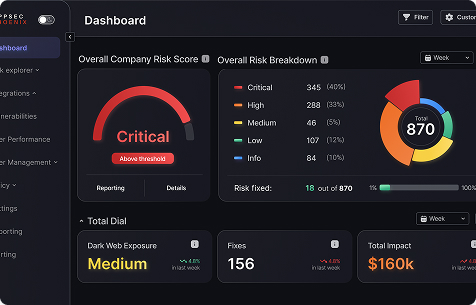









Phoenix Security connects code to runtime, auto-assigns ownership, prioritizes reachable exposure, and uses AI agents to drive opt-in fixes and remediation campaigns - at scale, with humans in control.
Full asset attribution (ClearBank) • Critical vulnerabilities reduced within weeks (Bazaarvoice) • 78% reduced container and SCA noise (Ad-tech)
Risk is measured at the board level, but disconnected from actual fixes
Too many findings.
No ownership, no clear remediation path
Prioritization without attribution & remediation is just a nicer spreadsheet.
Tickets arrive without context
Effort doesn’t map to real risk redu


be in control of application risk — from generation to remediation.
Maintain a living ownership graph so every issue routes to the right team, repo, and service—not a shared queue.
Who owns what?
Prioritize what’s deployed, running, and reachable—enriched with threat intel and business context.
Why does it matter?
AI agents generate minimum-impact fix plans and can open opt-in PRs, run campaigns, and measure risk reduction.
How do we fix it?
Unify findings from SAST, SCA, container, cloud, runtime, and ticketing into one normalized model—deduped and traceable from repo to deployment.
Auto-assign ownership using a living graph that stays accurate as systems and orgs change.
Prioritize with runtime reality and threat context.
Ship remediation with human-in-control agents.
Platform Overview
Phoenix ingests findings from every source, attributes ownership, prioritizes real exposure, and ships remediation — with AI agents and humans in control at every step.
Ingest or scan code, SCA, cloud, containers, and augment with development context and runtime context, containers, cloud, runtime, and AI-generated code into one normalized model — deduped and traceable from repo to deployment. Scan with AI to find with full context, trace dependencies, and find toxic combinations in code.
Auto-assign ownership using a living graph that stays accurate as systems and orgs change. Map assets to teams, repos, services, and programmatically embed the configuration in code with Phoenix PYRUS code CMDB.
Validate real exploitability with agentic runtime reachability, threat intel, and business context. Remove noise from non-running assets. Focus on what's actually deployed and reachable — not scanner severity labels.
Triage Code, Container, Cloud, prioritizing a real, validated exploit. Phoenix Security (phoenix purple) minimizes false positives with 20% more accurate detection than Claude and 30% more accurate than Codex, focusing exclusively on real vulnerabilities with verified exploits. This is achieved by combining deep taint graph analysis with our multi-pass agentic verification pipeline. The result is a definitive list of risks—validated by Exploit Developer AI personas—that are genuinely reachable and exploitable in your codebase.
Remediate Code, Cloud Critical findings with AI agents proposing the best path to remediation and triage like a security engineer, code augmented with cloud context, open PRs automatically, and run campaigns across thousands of repos — with human approval at every step.
Unify findings from SAST, SCA, containers, cloud, runtime, and AI-generated code into one normalized model — deduped and traceable from repo to deployment.
Auto-assign ownership using a living graph that stays accurate as systems and orgs change. Map assets to teams, repos, services, and on-call.
Validate exploitability with runtime reachability, threat intel, and business context. Focus on what's actually deployed and reachable.
AI-powered triage removes false positives, enriches context, and routes findings to the right team — automatically.
AI agents propose minimum-impact fix plans, open opt-in PRs, and run campaigns across thousands of repos — with human approval at every step.
Composable security coverage across your entire software lifecycle. Deploy what you need, when you need it.
Mission control for your attack surface.
The surgeon. Full-context, graph-powered code security.
Intelligence that blocks before damage is done.
From finding to fix in a pull request.
Continuous AI penetration testing.
“Phoenix is a User Friendly Product That Provides A Wide Range of Powerful Functionality.”
The product is easy to use It has a lot of functionality, which is also easy to navigate between The functionality within the platform is powerful and connects up to give a platform that can improve risk management at every level.
“Essential product for security teams – AppSec and CSPM in a single view.”
The Phoenix team is quick to respond and always willing to help. They have implemented custom features and listened to our feedback. The product is progressing so quickly for a startup and I love having input into what we need next. What makes them unique is that they have done our job so understand the pain AppSecOPS teams go through.
“Effortless Customization Reduces User Workload, But Costs Unclear”
It has a simple and intuitive UI. Excellent, user-friendly interface with lots of customization options makes it fruitful to use and helps achieve our specific security requirements easily.
“Contextualized and unified references with application architecture.”
Comprehensive coverage and real-time threat detection. It helps manage compliance requirements and can integrate with other tools especially feeding SIEM. Certain tasks such as vulnerability scanning and patch management can be automated through scheduling. Depending on use case its checks on ACT risks and API deploy are valuable to check for errors or patterns.
Stop prioritizing vulnerabilities. Start shipping remediation.
|
Stop prioritizing vulnerabilities. Start shipping remediation.
|
Stop prioritizing vulnerabilities. Start shipping remediation.
|
Stop prioritizing vulnerabilities. Start shipping remediation.
|
Phoenix Security accelerates triage, ownership, and remediation while keeping engineering workflows clean and auditable.
*Tracked across code, containers, cloud, and runtime.
Assets attributed in real time (code → cloud → runtime)
Code to Container vulnerabilities removed with agentic correlation
Critical removed
with agentic attribution

Lorem ipsum dolor sit amet, consectetur adipiscing elit. Ut elit tellus, luctus nec ullamcorper mattis, pulvinar dapibus leo.
Scanning tools find vulnerabilities. ASPM tells you which ones actually matter. Application Security Posture Management connects findings from SAST, SCA, containers, and cloud into one normalized model — then adds runtime context, ownership, and business risk. The result: 98% less noise, and a clear path to remediation. Scanners give you a list. ASPM gives you a plan.
No. Phoenix ingests findings from 30+ scanners — Snyk, Wiz, Qualys, Prisma, and more — without ripping anything out. You keep your existing tools. Phoenix deduplicates, normalizes, and adds the context your scanners can’t provide: reachability, ownership, and exploit intelligence. Most teams reduce their critical backlog by over 90% without changing a single scanner.
Phoenix builds a living ownership graph from your repos, pipelines, service catalogs, and on-call data. It maps every vulnerability to the team responsible — not a shared queue. As your org changes, the graph self-heals. No more “who owns this?” tickets. Every finding has an owner before it reaches a developer.
Most teams prioritize by CVSS score. Phoenix prioritizes by what’s actually running and reachable in production right now. A critical CVE in a container that never runs is not your problem. A medium CVE in a reachable service with a public exploit is. Phoenix combines runtime reachability, CISA KEV, EPSS, and threat intel to surface the 2–3% of findings that represent real risk.
Phoenix AI agents analyze the full dependency graph, identify the minimum-impact upgrade path, and generate a fix plan. They open opt-in PRs — nothing merges without developer approval. Agents run campaigns across thousands of repos simultaneously, but every fix goes through your existing review process. Humans stay in control at every step.
Yes. Phoenix remediates across code (SAST), containers, cloud misconfigurations, and infrastructure. The AI agent understands the full stack — it doesn’t just bump a package version. For container vulnerabilities, teams have seen 98% reduction. For cloud critical findings, Phoenix generates fix plans that account for blast radius and compensating controls.
Most teams connect their first scanner in under 30 minutes. Within 24 hours, Phoenix has deduplicated findings, assigned ownership, and surfaced the top 10 risks by reachable exposure. ClearBank reduced their critical container vulnerability count to zero within weeks. Bazaarvoice cut their critical exposure by 94%. You don’t need a 6-month implementation to see results.
See Phoenix Security turn fragmented vulnerability data into a team-owned fix backlog with attribution, reachability context, and agentic remediation—measured by vulnerabilities removed and exposure reduced.
Embrace the power of AI, utilize dynamic prioritization, and set targets with one click to ACT on Risk.
Derek Fisher – Head of product security at a global fintech. Speaker, instructor, and author in application security.
Derek is an award winning author of a children’s book series in cybersecurity as well as the author of “The Application Security Handbook.” He is a university instructor at Temple University where he teaches software development security to undergraduate and graduate students. He is a speaker on topics in the cybersecurity space and has led teams, large and small, at organizations in the healthcare and financial industries. He has built and matured information security teams as well as implemented organizational information security strategies to reduce the organizations risk.
Derek got his start in the hardware engineering space where he learned about designing circuits and building assemblies for commercial and military applications. He later pursued a computer science degree in order to advance a career in software development. This is where Derek was introduced to cybersecurity and soon caught the bug. He found a mentor to help him grow in cybersecurity and then pursued a graduate degree in the subject.
Since then Derek has worked in the product security space as an architect and leader. He has led teams to deliver more secure software in organizations from multiple industries. His focus has been to raise the security awareness of the engineering organization while maintaining a practice of secure code development, delivery, and operations.
In his role, Jeevan handles a range of tasks, from architecting security solutions to collaborating with Engineering Leadership to address security vulnerabilities at scale and embed security into the fabric of the organization.
Jeevan Singh is the Director of Security Engineering at Rippling, with a background spanning various Engineering and Security leadership roles over the course of his career. He’s dedicated to the integration of security practices into software development, working to create a security-aware culture within organizations and imparting security best practices to the team.
In his role, Jeevan handles a range of tasks, from architecting security solutions to collaborating with Engineering Leadership to address security vulnerabilities at scale and embed security into the fabric of the organization.
James Berthoty has over ten years of experience across product and security domains. He founded Latio Tech to help companies find the right security tools for their needs without vendor bias.
Chris Romeo is a leading voice and thinker in application security, threat modeling, and security champions and the CEO of Devici and General Partner at Kerr Ventures. Chris hosts the award-winning “Application Security Podcast,” “The Security Table,” and “The Threat Modeling Podcast” and is a highly rated industry speaker and trainer, featured at the RSA Conference, the AppSec Village @ DefCon, OWASP Global AppSec, ISC2 Security Congress, InfoSec World and All Day DevOps. Chris founded Security Journey, a security education company, leading to an exit in 2022. Chris was the Chief Security Advocate at Cisco, spreading security knowledge through education and champion programs. Chris has twenty-six years of security experience, holding positions across the gamut, including application security, security engineering, incident response, and various Executive roles. Chris holds the CISSP and CSSLP certifications.
Jim Manico is the founder of Manicode Security, where he trains software developers on secure coding and security engineering. Jim is also the founder of Brakeman Security, Inc. and an investor/advisor for Signal Sciences. He is the author of Iron-Clad Java: Building Secure Web Applications (McGraw-Hill), a frequent speaker on secure software practices, and a member of the JavaOne Rockstar speaker community. Jim is also a volunteer for and former board member of the OWASP foundation.
Get all the latest news, exclusive deals, and feature updates.